You have tried the painkillers. You have done the physiotherapy. You may have even had injections. And yet, weeks or months later, the pain keeps coming back — in your lower back, your neck, your joints, your muscles.
This is one of the most frustrating experiences a patient can have. You do everything right. You follow the advice. And the relief is temporary — or partial at best.
There is a reason for this. Most conventional pain treatments target the symptom — the inflamed tissue, the tight muscle, the compressed nerve. What they rarely address is the body’s underlying pain-signalling system: the network of sensory receptors, nerve pathways, and connective tissue junctions that decides how much pain you feel, where you feel it, and how long it persists.
Marma Chikitsa — Ayurveda’s system of vital point therapy — works directly on this network. It is one of the oldest and most sophisticated pain treatment systems in the world. And recent insights from neuromuscular science suggest there may be a precise biological reason it works — one that bridges a 3,000-year-old text with 21st-century physiology.
If you have been living with pain that nobody seems able to fix permanently, this article is for you.
Existing Treatment Options for Chronic Pain
When you see a doctor for chronic pain, the pathway is usually predictable. First, NSAIDs (anti-inflammatory tablets) or analgesics for short-term relief. If the pain persists: Pregabalin or Duloxetine — medications that dampen the nervous system’s pain signals. Steroid injections for localised pain that hasn’t responded to tablets. TENS (transcutaneous electrical nerve stimulation) therapy. Physiotherapy for movement and strengthening.
Each of these has genuine value. NSAIDs reduce inflammation effectively in the short term. Physiotherapy restores movement and prevents deconditioning. These are good tools.
But the average chronic pain patient has tried three to four different treatments before finding lasting relief. The reason: most treatments address the output — the pain signal — without addressing the system generating it. Physiotherapy rebuilds movement but often misses the neurological component of chronic pain: the sensitised nerve pathways, the misfiring muscle tone regulation, the disrupted autonomic balance that keeps the pain cycle going.
Patients with chronic back pain may spend six to twelve months in conventional management with partial improvement. Patients with fibromyalgia, chronic neck pain, or tension headaches often cycle between treatments for years without resolution.
Where Ayurveda Fits In — And Why the Science Is Catching Up
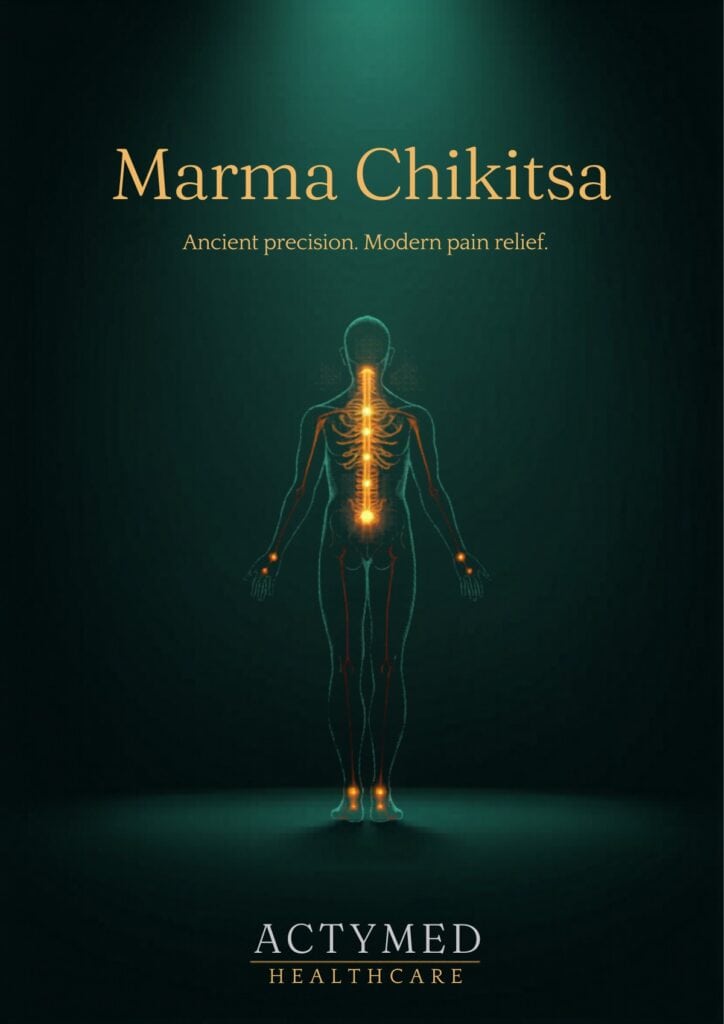
Ayurveda mapped 107 Marma points across the body over three thousand years ago. These points were not abstract energy locations. They were identified as precise anatomical junctions — meeting places of Mamsa (muscle), Snayu (tendons, ligaments, and fascia), Asthi (bone), Sandhi (joints), and Dhamani (vessels). Injury to a Marma point was considered serious. Therapeutic stimulation of a Marma point was considered powerfully corrective.
Modern anatomists who have overlaid the 107 Marma locations onto current atlases have found something remarkable: the majority of these points correspond to nerve plexuses, tendon insertions, neurovascular bundles, and fascial junctions. This is not coincidence. It is precision.
The Mamsa–Snayu Hypothesis: Muscle Spindles, GTOs, and Marma Points
This is where we arrive at something genuinely novel — a hypothesis that Dr. Ajeesh has developed through clinical observation at Actymed and through the intersection of sports physiology and classical Ayurvedic anatomy.
Mamsa Marmas are Marma points located within muscle tissue — specifically at the belly of the muscle, often near the neuromuscular junction. Snayu Marmas are located at tendinous and ligamentous junctions — precisely where muscle transitions to tendon, and where tendon attaches to bone.
Now consider two structures that every sports physiologist knows well:
The Muscle Spindle (intrafusal muscle fibre) is a sensory receptor embedded within the muscle belly. It detects changes in muscle length and the rate of that change. It fires Ia afferent nerve signals to the spinal cord, which then regulate the stretch reflex — the automatic contraction a muscle produces when it is stretched too far or too fast. In chronic pain, muscle spindles become hypersensitive. The stretch reflex threshold drops. The muscle stays in a state of low-grade chronic contraction — guarding, protecting, and perpetuating the pain.
The Golgi Tendon Organ (GTO) sits at the musculotendinous junction — exactly at the tendon insertion, precisely where Snayu Marmas are mapped. The GTO detects tension in the tendon. When tension exceeds a threshold, it fires Ib afferent signals that inhibit the motor neuron pool — causing the muscle to relax. This is called autogenic inhibition. It is the mechanism behind the “release” felt during sustained pressure on a tight tendon or in certain manual therapy techniques.
The hypothesis is this: Mamsa Marma stimulation acts on muscle spindle receptor fields, modulating Ia afferent sensitivity and resetting the stretch reflex loop. Snayu Marma stimulation acts on GTO receptor fields, triggering Ib afferent-mediated autogenic inhibition — producing the involuntary release of chronic muscular tension.
When Marma therapy is performed by a trained physician who applies the correct stimulus — appropriate pressure depth, medicated oil, or needling — at these anatomical junctions, the response is not mystical. It is a precise modulation of the gamma motor neuron system: the loop that governs resting muscle tone, stretch sensitivity, and neuromuscular inhibition.
This may explain something that has puzzled clinicians: why Marma therapy produces pain relief faster than conventional soft tissue therapy, and why the effect is often body-wide rather than localised to the treatment site. The gamma motor neuron loop is a distributed system. Resetting one node can recalibrate tension patterns across the entire myofascial chain.
This hypothesis requires formal investigation — Dr. Ajeesh welcomes academic collaboration. But the clinical results at Actymed are consistent with exactly this mechanism.
The Actymed Protocol for Chronic Pain with Marma Chikitsa
The Actymed approach identifies the underlying neurological and structural drivers — and addresses all of them simultaneously.
Marma Assessment and Stimulation
Before any treatment begins, Dr. Ajeesh conducts a detailed Marma assessment — mapping which specific Mamsa and Snayu Marma points are tender, restricted, or implicated in your pain pattern. Your pain has a specific anatomical signature. The Marma map for your case is individual. Stimulation is applied through precise pressure, warm medicated oil, or superficial needling at the identified points. The response is often immediate — a release of tension, a shift in pain quality, a sense of the body letting go of something it had been holding tightly.
Dry Needling — Where Classical and Contemporary Overlap
Dr. Ajeesh holds IAODN certification in Dry Needling (Myotatic Approach, founded by Dr. Ruhit Sanghvi, registered with the Texas Medical Board). Dry Needling targets myofascial trigger points — hypersensitive knots within muscle tissue that generate referred pain patterns. What is remarkable is the anatomical convergence: many Marma points and myofascial trigger points occupy the same neuromuscular locations. When the Marma map and the trigger point map are used together, the therapeutic precision is significantly higher than either system used in isolation. The needle produces a twitch response — a brief involuntary muscle contraction that releases the trigger point and resets neuromuscular function. Viewed through the Mamsa–Snayu hypothesis, this twitch is a Ia afferent-mediated spinal reflex — a reset of the stretch reflex arc at the level of the anterior horn.
Rakta Mokshana (Ayurvedic Cupping)
Following Marma stimulation and Dry Needling, Rakta Mokshana (Ayurvedic cupping) is applied to the treated regions. The decompressive force of cupping lifts the fascial layers, draws fresh blood supply to tissue that has been starved of circulation, and removes the metabolic waste products that accumulate in chronically tight muscles. At Actymed, cupping is always Rakta Mokshana — rooted in the Shalya Tantra tradition. The combination of needling and cupping at the same Marma site addresses both the intrafusal fibre dysfunction (Dry Needling) and the extrafusal circulatory stasis (cupping) simultaneously.
Specialised Ayurvedic Procedures — Janu Basti, Greeva Basti, Kati Basti
For chronic pain with a joint component — knee pain, cervical pain, lumbar pain — specialised procedures pool warm medicated oil directly over the affected joint. Janu Basti for the knee, Greeva Basti for the neck, Kati Basti for the lower back. The medicated oil penetrates the periarticular connective tissue, reduces Vata-mediated degeneration, and nourishes the Snayu (ligamentous tissue) at the joint. These procedures are performed immediately following Marma stimulation — when the tissue is in its most receptive state.
Ayurvedic Medicines and Medicated Oils
Internally, classical Ayurvedic formulations reduce systemic inflammation, nourish the nervous system, and support tissue repair. Ashwagandha and Bala strengthen musculoskeletal tissue and modulate the stress axis. Dashamoola reduces Vata-type distributed pain. Medicated oils — Ksheerabala taila, Dhanwantharam taila — are used in Abhyanga (therapeutic oil massage) to penetrate deep tissue. These oils are not simply lubricants; their lipid-soluble active compounds are absorbed transdermally and act on local nociceptors and inflammatory mediators.
Therapeutic Exercise and Postural Rehabilitation
Marma therapy and Dry Needling reset the dysfunction. Lasting recovery requires retraining. Therapeutic exercises are prescribed specifically for your pain pattern — rebuilding the neuromuscular coordination, restoring functional range of motion, and correcting the movement habits that contributed to the problem. Each progression is confirmed before advancing. The goal is not just pain relief — it is a body that moves without guarding.
The synergy is why this protocol succeeds where individual treatments have not. Marma therapy resets the gamma motor neuron loop. Dry Needling releases trigger point-mediated tone. Rakta Mokshana (Ayurvedic cupping) restores circulation and fascial mobility. Specialised procedures nourish the periarticular tissue. Medicines address systemic Vata imbalance. Exercise rebuilds function. Each layer deepens the effect of the others.
Why Patients Recover Faster at Actymed
With conventional pain management, most chronic pain patients achieve partial relief over six to twelve months — and many never reach full resolution.
At Actymed, most patients with chronic pain report a noticeable change within the first two to three Marma sessions. The reason is mechanistic: Marma therapy — when performed at the correct Mamsa and Snayu points — directly modulates the neuromuscular tone regulation system. This is the fastest route to pain relief that does not require suppression of the nervous system with medication.
A typical Actymed chronic pain course — eight to twelve sessions over eight to ten weeks — achieves outcomes that most patients have been unable to achieve across years of conventional management. Conditions responding best in our experience include chronic back pain, neck and shoulder pain, sports injuries with a chronic component, fibromyalgia, tension headaches, and joint pain without significant structural damage.
Frequently Asked Questions
Does Marma therapy hurt?
Most patients describe the sensation as deep, focused pressure — occasionally intense for a moment, but not sharp or burning. The feeling is typically followed immediately by a sense of release and warmth. Patients who are apprehensive before their first session almost universally report the experience was far more comfortable than they expected.
How is Marma therapy different from acupressure?
Acupressure is rooted in Traditional Chinese Medicine and works on the meridian system — channels of Qi mapped in Chinese classical texts. Marma therapy works on the 107 anatomical points mapped in Ayurvedic anatomy, which correspond to neuromuscular and fascial junctions validated by modern anatomy. The theoretical frameworks, point locations, and treatment rationale are distinct, though some geographic overlap exists between the two systems.
What is the connection between Marma points and muscle spindles or GTOs?
This is the frontier of Marma research. Mamsa Marmas are mapped at muscle belly locations — consistent with muscle spindle receptor fields. Snayu Marmas are mapped at musculotendinous junctions — consistent with GTO locations. Dr. Ajeesh’s clinical hypothesis is that Marma stimulation modulates Ia and Ib afferent signalling, resetting the stretch reflex arc and reducing chronic neuromuscular tone. The clinical results at Actymed are consistent with this mechanism.
How many sessions will I need?
Acute conditions with a short history typically respond in four to six sessions. Chronic conditions — pain lasting more than three months — usually require eight to twelve sessions for full benefit. Dr. Ajeesh will give you a clear estimate after your first assessment based on your history and Marma findings.
What conditions respond best to Marma therapy at Actymed?
Marma therapy is most effective for chronic back pain, neck and shoulder pain, sports injuries, fibromyalgia, tension headaches, migraines, and joint pain where conventional treatment has produced only partial relief. It is particularly relevant wherever there is a neurological or autonomic component to the pain.
Can Marma therapy be combined with my existing physiotherapy?
Yes. Marma therapy and physiotherapy address complementary dimensions of chronic pain — neurological tone regulation versus movement and strength rehabilitation. The combination is often more effective than either alone. Dr. Ajeesh is happy to coordinate your protocol with your existing physiotherapist.
Is it safe for elderly patients?
Marma therapy involves no forceful manoeuvres. The stimulation is precise and controlled, making it one of the safest modalities in the Actymed protocol. Elderly patients with chronic joint pain, osteoarthritis, and age-related musculoskeletal conditions respond very well — often reporting improvement in both pain intensity and mobility within a few sessions.
Book Your Consultation at Actymed
If you have been living with pain that keeps returning despite multiple treatments, the missing piece may be a more precise address of the neuromuscular system driving it. At Actymed, we assess your pain at the level of the body’s own regulatory architecture — and treat it there.
Reach us at Actymed Healthcare, Thodupuzha, Perumbavoor, or Kottarakkara. Or start with a WhatsApp message — we are glad to understand your situation before you make the journey.